
Views: 222 Author: Amanda Publish Time: 2026-01-08 Origin: Site


Designing a hydraulic winch requires the coordinated selection of the hydraulic motor, planetary gearbox, drum, brake, control valves, structural frame and hydraulic power source. The design must balance line pull, line speed, duty cycle, safety, serviceability and operating environment so that the complete system performs reliably under the intended load.
This guide explains a practical engineering workflow for designing a hydraulic winch, from defining performance requirements to mechanical sizing, hydraulic circuit design, braking, structural mounting, controls, cooling, testing and validation.
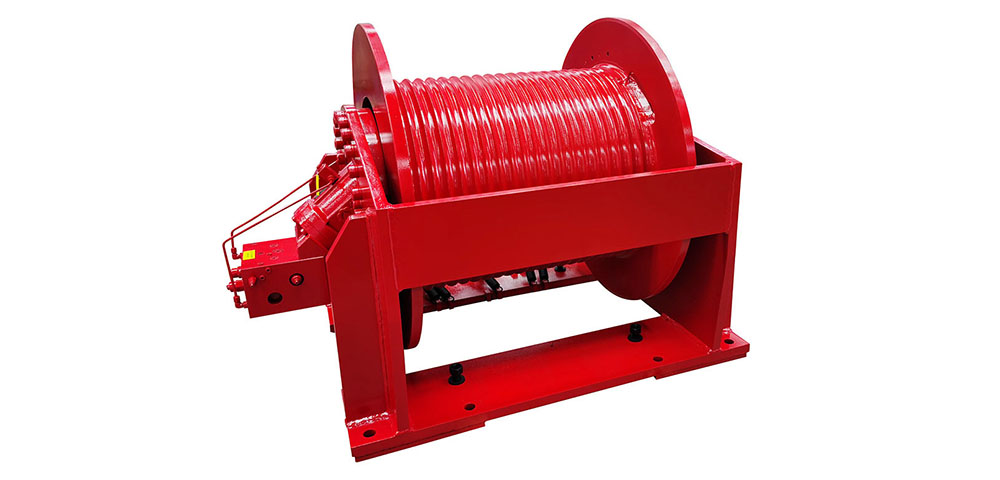
A hydraulic winch converts pressurized hydraulic energy into mechanical rotation at the drum. Hydraulic fluid drives a motor, the motor transfers torque through a reduction gearbox, and the drum converts that torque into rope pull and line speed. Brake and valve systems control starting, stopping, holding and lowering.
A typical system may include:
| Component | Primary Function |
|---|---|
| Hydraulic Power Source | Supplies hydraulic flow and pressure to the drive system. |
| Hydraulic Motor | Converts hydraulic energy into rotary torque and speed. |
| Planetary Gearbox | Reduces speed and increases torque at the drum. |
| Drum and Rope | Store the rope and transfer torque into line pull. |
| Brake System | Holds the load and provides controlled stopping. |
| Control Valves | Manage flow direction, pressure and load control. |
| Structural Frame | Transfers winch reaction forces into the supporting machine or foundation. |
In mobile machinery, the winch may share hydraulic power with travel drives, swing drives and other auxiliary functions. That makes hydraulic capacity, valve coordination and structural integration important from the beginning of the design.
Explore hydraulic winch solutions
Component selection should start with the required operating condition rather than with a motor or gearbox catalogue. Define the load, speed, rope, duty cycle and environment first.
| Design Input | Engineering Question |
|---|---|
| Rated Line Pull | What line pull is required, and on which rope layer? |
| Line Speed | What rope speed is required at the target load? |
| Rope | What diameter, construction and storage length are required? |
| Duty Cycle | Is the winch intermittent, high-cycle or continuous duty? |
| Environment | Marine, mining, construction, drilling, forestry or mobile equipment? |
| Hydraulic Supply | What pressure and flow are actually available at the winch? |
Defining these values early helps prevent a common design problem: selecting a component that meets one nominal specification but does not perform adequately at the actual operating point.
The drum determines the effective lever arm between the rope and the gearbox output. It therefore affects required torque, rope speed, rope capacity and structural loading.
Drum diameter should be selected according to the rope type, required bending ratio, line pull, rope storage and applicable design requirements. Rather than applying one fixed diameter-to-rope ratio to every winch, the final drum geometry should follow the rope manufacturer's requirements and the intended service conditions.
Drum width and flange height must accommodate the required rope length and winding layers while maintaining the specified rope clearance and guiding arrangement.
As the effective winding radius increases, more drum torque is required to produce the same line pull. At a fixed drum torque, the available line pull therefore decreases on larger rope layers.
Check the rope bending requirements against the drum core diameter.
Maintain an appropriate fleet angle for the application.
Use suitable fairleads or guide rollers where required.
Prevent excessive side loading, cross-winding and rope contact with sharp structural edges.
Planetary gearboxes are widely used in compact, high-torque winch drives because their coaxial architecture can provide substantial speed reduction within a relatively compact package.
| Selection Factor | Design Requirement |
|---|---|
| Output Torque | Must accommodate maximum drum torque and the applicable design margin. |
| Gear Ratio | Must match motor speed, drum speed and hydraulic flow availability. |
| Duty Rating | Continuous and peak torque ratings must match the operating cycle. |
| Mounting | Check flange, shaft, bearing and drum integration requirements. |
| Thermal Capacity | Confirm allowable temperature and lubrication requirements for the duty cycle. |
The required number of planetary stages depends on the target reduction ratio, input speed, output torque and package size. Higher overall reductions can be achieved by combining multiple stages, while each additional stage introduces additional mechanical losses and design considerations.
For a winch, the chosen ratio should allow the hydraulic motor to operate within its preferred torque and speed range while providing the required drum speed at the available hydraulic flow.
The motor converts hydraulic pressure and flow into shaft torque and speed. Motor displacement, pressure rating, speed capability, efficiency and starting torque all need to be matched to the gearbox and drum requirements.
| Motor Parameter | Why It Matters |
|---|---|
| Displacement | Determines torque at a given pressure and required flow at a given speed. |
| Working Pressure | Influences available motor torque and must remain within the manufacturer's rating. |
| Speed | Must match the selected gearbox ratio and required drum rpm. |
| Starting Torque | Important when starting under load and during low-speed operation. |
| Efficiency | Affects actual torque, speed, heat generation and system efficiency. |
Radial piston motors: commonly considered where very high starting torque and low-speed performance are required.
Axial piston motors: suitable for applications requiring a wide speed range and high-pressure operation within the selected model's limits.
Gear motors: compact and relatively simple for applications within their pressure, torque, speed and duty ratings.
Orbit or gerotor motors: useful for certain compact, low-speed hydraulic drive applications.
The final motor choice should be based on the complete application rather than motor type alone.
The hydraulic circuit determines how the winch starts, stops, accelerates, holds and lowers its load. It also determines how much of the available hydraulic power reaches the motor.
Provides the hydraulic flow and pressure required by the motor and other machine functions.
Controls forward, reverse, neutral and the selected operating mode.
Counterbalance, over-center and pressure-control functions help manage the load.
Depending on the machine, the circuit may use open-center, closed-center or load-sensing architecture. The selected control method must match the host hydraulic system and the winch manufacturer's circuit requirements.
Hose sizes, fittings and valve selection should limit unnecessary pressure loss while maintaining sufficient flow at the motor.
The brake system must hold the required static load and work predictably during stopping and restarting. For lifting and suspended-load applications, braking is a system-level safety function rather than simply a motor accessory.
A common arrangement uses springs to apply the brake and hydraulic pressure to release it. The exact brake torque, release pressure and control arrangement must be selected for the specific winch.
Brake holding torque must be evaluated against maximum static drum torque, rope layer, load condition and the applicable design requirements.
Counterbalance or over-center control where required.
Pressure relief protection.
Mechanical guarding.
Drum and rope limit monitoring where applicable.
Emergency-stop logic appropriate to the machine.
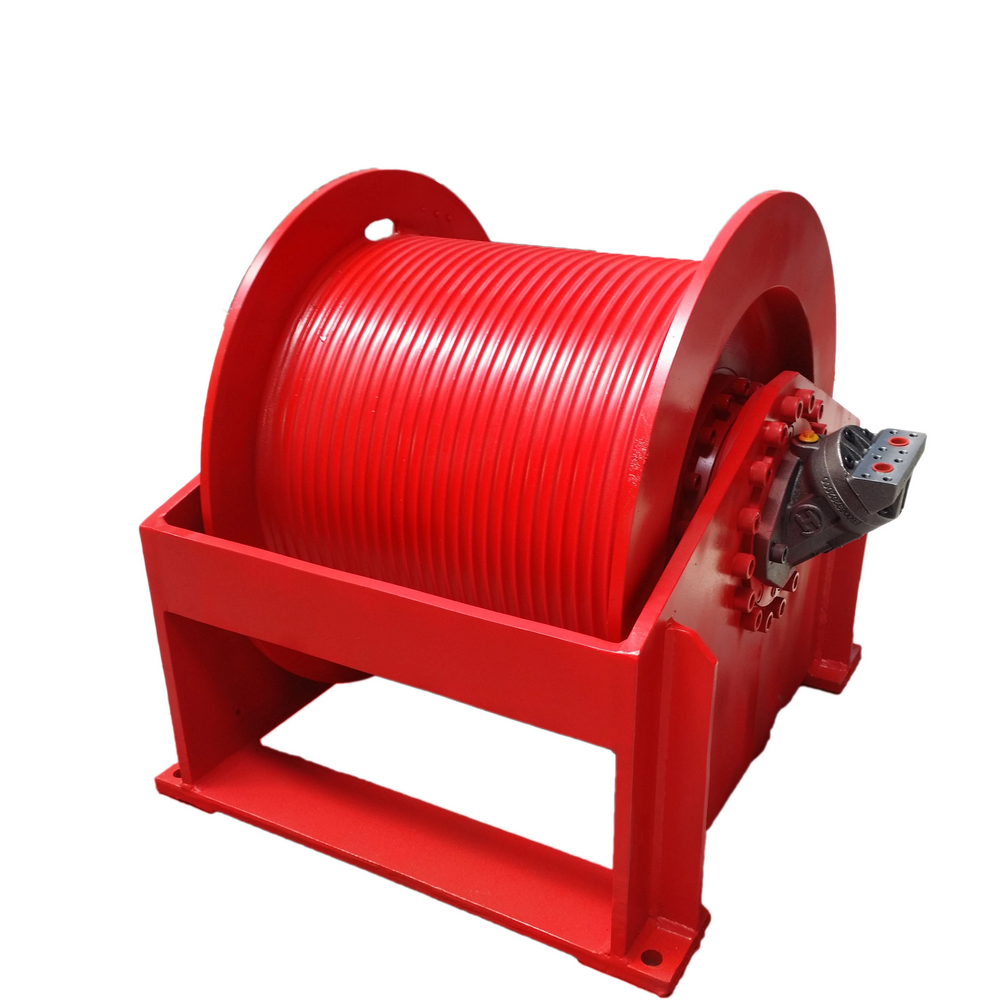
The frame transfers drum reaction forces, gearbox torque and rope loads into the machine structure or foundation. A correctly sized hydraulic circuit cannot compensate for a weak or poorly aligned mechanical installation.
| Structural Area | Design Consideration |
|---|---|
| Base Frame | Control deflection and distribute reaction loads into the chassis. |
| Mounting Interface | Follow approved bolt patterns, locating features and mounting tolerances. |
| Welded Structure | Review high-stress joints, fatigue conditions and required inspection. |
| Rope Entry | Maintain a suitable rope path and fleet angle. |
| Environment | Provide appropriate corrosion protection for marine, offshore or abrasive environments. |
Control architecture should be matched to the operating environment, required precision and machine complexity. A small mobile winch may use direct manual control, while a production machine or marine system may require proportional hydraulic or electronic control.
Simple, robust control for applications where manual operation and basic speed regulation are sufficient.
Allows smoother speed adjustment through proportional valves and electronic controls.
Sensors can be used to monitor drum speed, rope position, hydraulic pressure and other operating data where the application requires it.
Advanced applications may also use constant-tension control, load-sensing hydraulics, remote control and data logging. Each feature should be evaluated against the machine's actual operating requirements.
Hydraulic losses and mechanical friction are converted into heat. High-cycle or continuous winch applications therefore require attention to efficiency, oil temperature and contamination control.
| Area | Recommended Design Focus |
|---|---|
| Hydraulic Efficiency | Minimize unnecessary throttling and pressure losses. |
| Cooling | Provide sufficient heat rejection for the required duty cycle. |
| Filtration | Maintain fluid cleanliness appropriate to the pumps, motors and valves. |
| Hose Routing | Minimize unnecessary hose length, sharp bends and restrictive fittings. |
Oil temperature limits should be taken from the actual components used. There is no single universal temperature target suitable for every hydraulic winch system.
A professional winch design should be validated through engineering calculations, inspection and physical testing appropriate to the intended application.
| Validation Area | Example Check |
|---|---|
| Structural Analysis | Check drum, frame, brackets and mounting structure for expected loads. |
| Gearbox | Verify torque, speed, bearing and thermal ratings. |
| Brake | Check load-holding capacity and controlled release behavior. |
| Hydraulic Test | Confirm pressure, flow, rotation and operating response. |
| Load Test | Verify performance at the approved test condition. |
| Documentation | Record configuration, inspection and test results for future service. |
Applicable standards and classification requirements depend on the application, jurisdiction and industry. The final design should be checked against the standards that actually apply to the equipment.
On drilling rigs, crawler carriers, pipeline machinery and other tracked equipment, the winch often shares the machine's hydraulic and structural resources with travel and auxiliary functions.
Confirm pump capacity and pressure availability when travel, swing or other functions operate simultaneously.
Transfer winch loads into the chassis through a properly designed mounting structure.
Maintain access to the motor, hoses, fittings, filters and inspection points.
For OEM equipment, the winch, planetary gearbox, hydraulic motor, travel drive and crawler undercarriage can be considered as a matched mechanical and hydraulic system.
View hydraulic winch, gearbox and drive solutions
Define rated line pull and rope layer.
Define loaded and no-load line speeds.
Select rope diameter, construction and storage length.
Determine drum geometry and effective winding radius.
Calculate required drum torque and speed.
Select gearbox ratio and torque capacity.
Select motor displacement, pressure and speed range.
Match pump, valves, hoses and cooling.
Design the brake and load-control system.
Validate the structure and mounting interface.
Test the completed assembly under approved conditions.
Document the final configuration for service and spare parts.
Designing a hydraulic winch is a system-engineering task rather than a simple motor-selection exercise. The process starts with line pull, line speed, rope and duty-cycle requirements and then moves through drum geometry, gearbox selection, hydraulic motor sizing, hydraulic circuit design, braking, structure, control and thermal management.
A reliable design also requires validation of the complete load path. The drum, gearbox, motor, brake, hydraulic circuit and supporting frame must work together within their respective torque, speed, pressure, temperature and structural limits.
For OEM projects, an integrated approach can simplify installation and help align the winch with the machine's existing hydraulic system, planetary drives, travel drives and crawler undercarriage.

A typical system includes a hydraulic power source, hydraulic motor, reduction gearbox, drum, brake, structural frame, hydraulic valves, hoses, filtration and oil management components.
Calculate drum torque from line pull multiplied by effective drum radius. Then account for gearbox ratio and efficiency to determine the motor-side torque requirement. The final design margin depends on the duty cycle, load characteristics and applicable engineering requirements.
Planetary gearboxes provide a coaxial transmission layout with substantial reduction capability and high torque density. This makes them well suited to compact winch packages where motor speed must be reduced substantially before reaching the drum.
Safety is addressed through suitable braking, load-control valves, pressure protection, structural design, machine guarding, control logic, inspection and commissioning procedures. The exact safety architecture depends on the winch and application.
Typical maintenance includes inspection of hydraulic hoses and fittings, rope condition, brake operation, gearbox lubrication, mounting hardware and oil cleanliness. The actual inspection and service intervals should follow the manufacturer's maintenance documentation and operating environment.
Send us your required line pull, line speed, rope diameter, drum dimensions, hydraulic pressure and flow, duty cycle and machine application. Kemer can evaluate the winch drive, gearbox, hydraulic motor and mounting requirements as an integrated system.
Request a Hydraulic Winch Quote


