
Views: 222 Author: Amanda Publish Time: 2026-01-10 Origin: Site


Content Menu
● What Is a Long Reach Excavator?
● Why High-Performance Aftermarket Parts Matter
● Leading Excavator Brands Used for Long Reach
● Popular Base Models and Transport Considerations
● How Long Reach Kits Transform Standard Excavators
● What a Complete Long Reach Package Typically Includes
● Ideal Excavator Sizes and Real-World Applications
● Configuring Long Reach Excavators for Dredging
● Complementary Systems and Attachments
● Engineering Expertise and Quality Considerations
● Practical Steps to Plan a Long Reach Upgrade
● Advanced Use Cases and Project Scenarios
● FAQs About Long Reach Excavator Booms and Sticks
>> 1. What is the main advantage of a long reach excavator?
>> 2. Can long reach systems be installed on any excavator?
>> 3. How does a long reach configuration affect lifting capacity?
>> 4. Are long reach excavators suitable for dredging projects?
>> 5. What other upgrades complement a long reach boom and stick?
Long reach excavator booms and sticks are a powerful way to extend reach, improve productivity, and expand the capabilities of existing machines without buying new equipment. They allow contractors to work deeper, farther, and safer across a wide range of demanding applications.
A long reach excavator uses an extended boom and stick assembly to achieve significantly greater horizontal and vertical reach compared with a standard factory configuration. This configuration enables operators to access work areas that would otherwise require larger machines or complex temporary works.
Key characteristics include:
- Extended boom and stick geometry versus standard booms.
- Increased digging depth and working radius, often by 50% or more depending on model and kit.
- Purpose-built design for applications such as deep excavation, dredging, and barge or shoreline work.
Using high-quality aftermarket components for long reach conversions can bring substantial operating and financial advantages. Contractors can upgrade existing machines to meet new project requirements while controlling capital expenditure.
Core economic benefits include:
- Lower acquisition cost than purchasing a new machine of similar working envelope.
- Faster payback period because productivity gains are high relative to investment.
- The ability to extend fleet life, delaying or reducing the need for full machine replacement.

Understanding common base machines helps in planning upgrade paths and evaluating resale value. A wide range of popular excavators are suitable for long reach booms and sticks.
Well-known manufacturers include:
- Volvo CE
- Caterpillar (CAT)
- Komatsu
- Doosan
- Hitachi
- JCB
- Liebherr Group
- Deere & Company
- Hyundai Heavy Industries
- Case CE
These brands supply many of the base machines that are later retrofitted with extended fronts for specialized jobs.
Mid- and large-size excavators are frequently selected as platforms for long reach conversions because they offer a strong balance of power, weight, and hydraulic capacity.
Model example | Operating weight | Typical class | Approximate power | Transport notes |
22–24 t unit | Around 22.4 t | Standard size | About 170–180 hp | Often moved without major disassembly |
35–37 t unit | Around 36.5 t | Standard/large size | 300+ hp | Usually transportable with limited tear-down |
45–48 t unit | Around 46.9 t | Large size | High-power class | May require partial disassembly for road transport |
While operating weights and power vary by brand and model, the standard digging depth range between many mid- and large-size units is often only a few feet. This relatively narrow difference makes long reach kits an efficient way to unlock much larger increases in reach and depth.
A carefully engineered long reach upgrade can change a conventional excavator into a machine capable of covering nearly twice the working area from a single setup point. This transformation has a direct impact on productivity, safety, and fuel efficiency.
Key performance gains:
- Reduced repositioning of the excavator, which lowers idle time and fuel consumption.
- Wider working envelope, allowing operators to complete more of the job from safer setback positions.
- The potential for up to double the reach compared with standard boom and stick assemblies, depending on machine and kit configuration.
For example, a standard reach configuration around 38 ft can often be upgraded to roughly 70 ft of reach with the right long reach package.
A complete long reach excavator package is designed as a system so that all structural and hydraulic components work together reliably. Selecting a package, rather than mixing unrelated parts, helps protect both performance and safety.
Common elements include:
- Long reach boom with optimized geometry for extended work.
- Long reach stick (arm) to increase digging depth and horizontal reach.
- Matched bucket and pins sized to maintain stability and productivity.
- Dedicated hydraulic cylinders for boom, arm, and bucket, tuned to the longer front.
- Pre-plumbed hydraulic lines and, when needed, integrated routing for slurry or auxiliary lines.
High-end systems are manufactured from high-strength steel plate and use advanced welding processes to support heavy-duty cycles and long service lives.
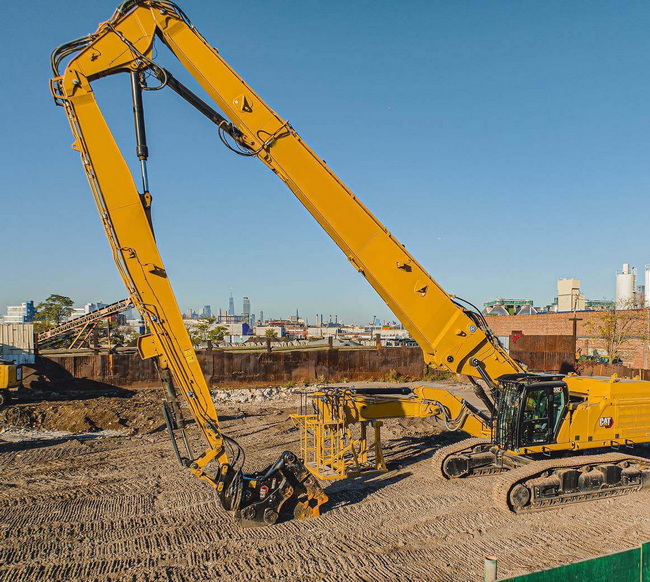
Long reach packages are widely available for machines in the 10–40 t and larger range, which covers many of the most common excavators on civil, industrial, and marine projects.
Typical applications:
- Deep excavation for foundations, basements, and shafts.
- Slope work and embankment shaping on dams, canals, and riverbanks.
- Demolition where stand-off distance improves safety for the operator and surrounding assets.
- Barge and shoreline projects where machines operate from fixed or floating platforms.
By configuring the right long reach front, a single excavator can take on specialized jobs that previously required niche or larger equipment.
Long reach excavators are especially effective in dredging applications when paired with suitable attachments. This setup enables precise removal of sediments and debris without the need for full-sized dedicated dredging vessels.
A typical dredging configuration includes:
- Long reach boom and stick for underwater access and extended horizontal reach.
- A dredge pump mounted at the front to move slurry, silt, and debris.
- An optional cutter head to break up compact or consolidated material before pumping.
This configuration is used for maintaining rivers, lakes, canals, harbors, and other waterways where controlled excavation and material removal are critical.
Long reach conversions often form just one part of a broader upgrade strategy. Pairing extended fronts with advanced control and mobility systems can significantly increase overall effectiveness.
Common complementary solutions:
- RTK GPS positioning systems for real-time depth, location, and grade control feedback.
- Amphibious undercarriages for operations in marshes, wetlands, and shallow water.
- Modular or sectional barges that act as floating platforms for excavators and related equipment.
Integrating these elements around a long reach front supports precise, efficient, and safe performance across challenging job sites.
Long reach booms and sticks place different stresses on the base machine than standard configurations, which makes engineering quality critical. Proper design, materials, and testing help ensure structural integrity over the entire working envelope.
Important quality factors:
- Use of high-strength structural steels and appropriate plate thicknesses at high-stress zones.
- Advanced fabrication methods, including robotic welding and strict process controls.
- Detailed evaluation of load charts, hydraulic capacities, and stability for each machine and configuration.
Working with a specialist supplier that focuses on excavator modifications helps ensure that long reach systems are engineered and supported to professional standards.
A structured planning process reduces risk and helps match long reach solutions to real project needs. Following a step-by-step approach ensures that technical and commercial objectives remain aligned.
1. Define the core application.
Clarify expected depth, horizontal reach, material type, and cycle times across target projects.
2. Evaluate candidate base machines.
Review machine weight class, hydraulic capacity, undercarriage configuration, and transport limits.
3. Select a compatible long reach package.
Match a proven kit to the specific model, including boom length, stick length, bucket size, and auxiliary options.
4. Plan installation and commissioning.
Schedule mechanical installation, hydraulic setup, and functional testing before deployment.
5. Update operating procedures and training.
Ensure operators understand the new working envelope, load limitations, and safe operating practices.
This approach supports both performance gains and long-term reliability on site.
Long reach excavators are increasingly used in specialized projects where traditional methods are either too slow, too risky, or too costly. These machines can often replace multiple conventional setups with a single, carefully configured solution.
Representative scenarios:
- Urban deep excavations where access is restricted and working from a safe distance is essential.
- Coastal defense and flood control projects that require shaping and maintaining embankments over wide areas.
- Industrial lagoons and tailings ponds where controlled material removal must be combined with strict safety procedures.
In each case, optimized reach and stand-off distance help improve both operational efficiency and risk management.
For contractors and asset managers looking to expand capability, reduce cost per cubic meter, and win more specialized work, investing in a well-engineered long reach excavator solution is a strategic move. Evaluating boom and stick options, compatible attachments, and supporting systems based on real project requirements is the first step toward a higher-performing fleet.
To move forward, review the machines in your current lineup, identify upcoming projects that demand extended reach, and request a tailored configuration and quotation from a specialist long reach provider. By sharing target applications, base machine models, and performance goals, you can receive a precise proposal that accelerates upgrade decisions and ensures each excavator delivers maximum value on site. Contact Kemer to get more information!
The primary advantage is a much larger working envelope, which allows operators to dig deeper and farther while repositioning the machine less frequently. This leads to higher productivity, lower fuel use, and improved safety in many applications.
Not every excavator is a suitable candidate, but many popular models from leading manufacturers can be upgraded with the right engineered kit. Compatibility depends on factors such as weight class, hydraulic capacity, and structural design, so each machine must be evaluated individually.
Extending boom and stick length changes leverage and load distribution, so rated lifting capacity at maximum reach is generally lower than with a standard front. For this reason, up-to-date load charts and safe working practices are essential whenever long reach systems are used.
Yes, long reach excavators are widely used in dredging when paired with suitable pumps and, where needed, cutter heads. This combination allows controlled removal of sediments and debris from rivers, lakes, canals, and harbors while working from banks, barges, or platforms.
Common complementary upgrades include RTK GPS guidance for precise depth and location control, amphibious undercarriages for soft or flooded terrain, and sectional barges that provide stable floating work platforms. Together, these systems help unlock the full potential of long reach excavator configurations.


