
Views: 222 Author: Amanda Publish Time: 2026-01-09 Origin: Site


A three-stage planetary gearbox combines multiple reduction stages to achieve high speed reduction and high output torque in a compact coaxial package. This guide explains the basic planetary gearbox ratio formula, the Willis equation, multi-stage ratio calculation, a worked 100:1 example, torque and efficiency relationships, and key design considerations.

A planetary gearbox consists of three main gear elements: a central sun gear, multiple planet gears mounted on a carrier, and an internal ring gear. In a common reduction arrangement, the motor drives the sun gear, the ring gear is fixed, and the planet carrier provides the output.
The central gear receives input power from the motor or hydraulic motor.
Planet gears mesh with both the sun and ring gears and are carried by the planet carrier.
The ring gear has internal teeth and is fixed in the common reduction configuration described in this guide.
Because several planets can share the transmitted load, planetary gearboxes can provide high torque density in a compact, coaxial arrangement. They are commonly used in travel drives, hydraulic winches, swing drives and other mobile or industrial power transmissions.
For the common configuration where the sun gear is the input, the ring gear is fixed and the carrier is the output, the basic reduction ratio is:
Where:
Zr = number of teeth on the ring gear
Zs = number of teeth on the sun gear
i = reduction ratio
Assume a sun gear with 20 teeth and a ring gear with 80 teeth:
Under this configuration, the output speed is approximately one-fifth of the input speed before accounting for losses, while output torque increases according to the transmission ratio and system efficiency.
The formula applies only to this specific kinematic arrangement. When a different member is fixed or used as the input or output, the ratio must be calculated using the corresponding planetary gear relationship.
For more general planetary gear arrangements, engineers can use the Willis equation to relate the angular velocities of the sun gear, ring gear and carrier:
Where:
ωs = sun gear speed
ωr = ring gear speed
ωc = carrier speed
k = Zr / Zs
If the ring gear is fixed, then ωr = 0 and the equation becomes:
The same relationship can be used for other planetary arrangements by defining which member is fixed, which member receives input and which member provides output.
A multi-stage planetary gearbox connects several planetary reduction stages in series. The output of one stage becomes the input to the next stage, allowing the overall reduction ratio to increase without requiring a large single-stage gear set.
For a three-stage planetary gearbox:
Using moderate reductions in each stage allows designers to reach high total reductions while keeping the transmission coaxial and relatively compact.
For a three-stage arrangement using the same sun-input, fixed-ring and carrier-output configuration in each stage, calculate each stage separately and then multiply the stage ratios.
| Stage | Sun Gear | Ring Gear |
|---|---|---|
| Stage 1 | Zs1 | Zr1 |
| Stage 2 | Zs2 | Zr2 |
| Stage 3 | Zs3 | Zr3 |
For each stage using the standard configuration:
Therefore:
Stage 1: i1 = 1 + Zr1 / Zs1
Stage 2: i2 = 1 + Zr2 / Zs2
Stage 3: i3 = 1 + Zr3 / Zs3
Consider a three-stage planetary gearbox used for a crawler travel drive or hydraulic winch drive. Assume the following tooth counts:
| Stage | Sun Teeth | Ring Teeth | Stage Ratio |
|---|---|---|---|
| Stage 1 | 20 | 80 | 5:1 |
| Stage 2 | 18 | 72 | 5:1 |
| Stage 3 | 24 | 72 | 4:1 |
If the input speed is 1,500 rpm, the idealized output speed based on the calculated ratio is:
Actual output speed and torque will depend on the real transmission efficiency, load, lubrication, bearing condition and operating point.
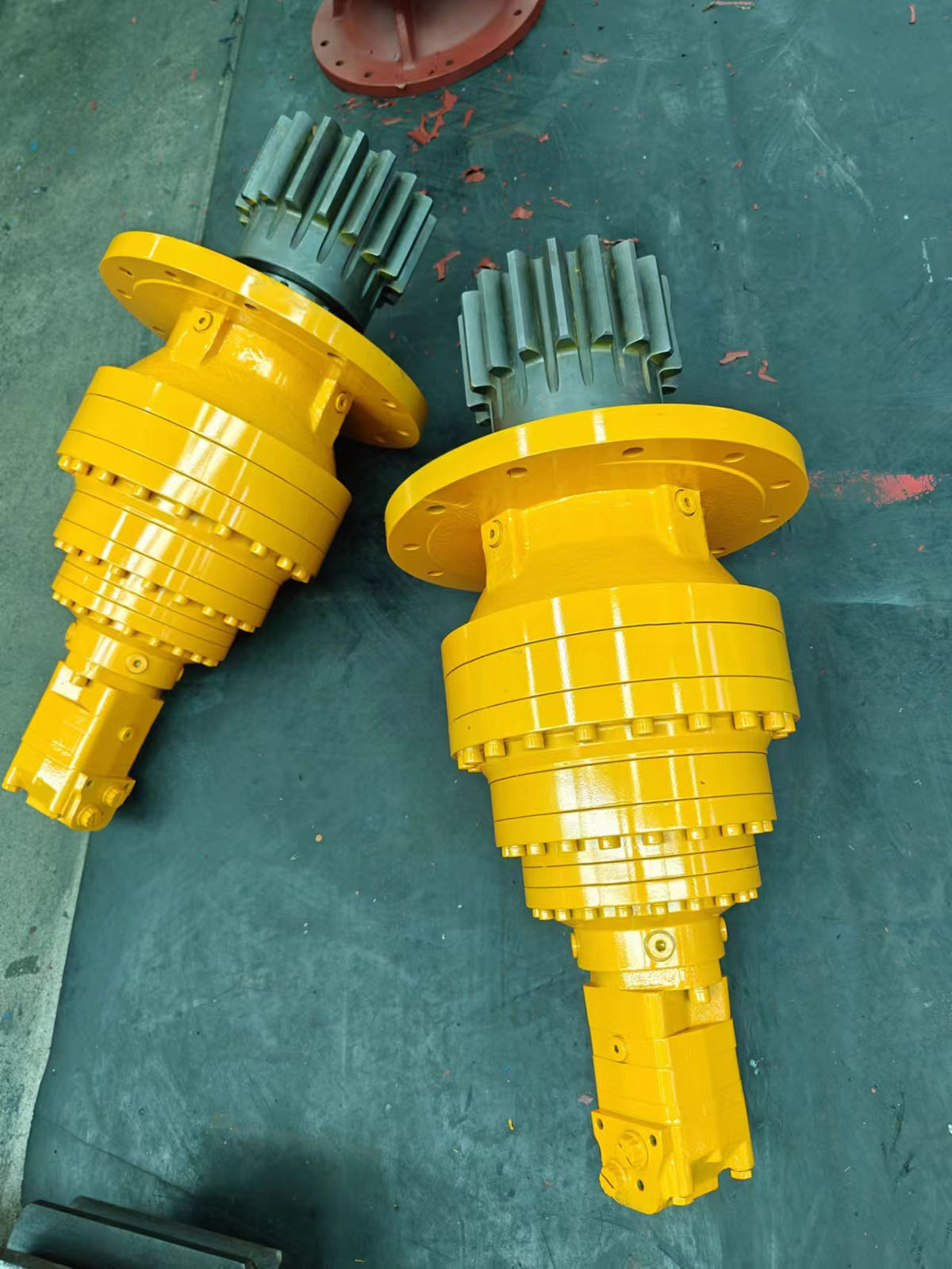
Tooth selection for a planetary gearbox is governed by both gear geometry and assembly requirements. The sun, ring and planet gears need compatible module and geometry, and the selected tooth counts must support the intended planet arrangement.
The sun and ring gears must use compatible gear geometry, including module and pressure angle.
The ring, sun and planet tooth counts must satisfy the required center-distance relationship.
Planet count and tooth counts must be checked for the intended assembly arrangement and spacing.
Very small sun gears may increase the risk of undercutting and reduced tooth-root strength depending on the gear geometry.
A higher reduction ratio reduces output speed and increases available output torque. In an ideal loss-free transmission, torque multiplication follows the transmission ratio. Real planetary gearboxes have efficiency losses at gear meshes, bearings, seals and the lubrication system.
For illustration, if each stage were 97% efficient:
This example gives approximately 91.2% overall transmission efficiency. Actual efficiency should be taken from the specific gearbox design or verified by testing rather than assumed as a universal value.
For the 100:1 example and the illustrative 91.2% efficiency, the calculated torque multiplication would be approximately 91.2 times the input torque. The actual usable output torque remains limited by gear strength, bearings, shafts, lubrication, thermal capacity and the duty cycle.
The achievable ratio of a three-stage planetary gearbox depends on the tooth counts, kinematic arrangement and mechanical design. Rather than treating one total range as universal, it is more useful to look at representative combinations.
| Stage Ratios | Total Ratio | Example |
|---|---|---|
| 4:1 × 4:1 × 4:1 | 64:1 | Three equal stages |
| 3:1 × 4:1 × 5:1 | 60:1 | Mixed stage ratios |
| 5:1 × 5:1 × 4:1 | 100:1 | Worked example above |
Actual commercially available ratios vary by gearbox architecture and manufacturer. Final ratio selection should be based on required motor speed, output torque, duty cycle, gear strength and application requirements.
Planet carriers, shafts and bearings must withstand the radial and axial loads generated by the transmitted torque. Designers should evaluate bearing capacity, shaft stiffness, fatigue strength and the load distribution between planetary gears.
The gearbox housing must maintain the alignment of the ring gears, carriers and bearings across all stages. Accurate machining and rigid mounting help control deflection, uneven loading and noise.
Mounting interfaces should also be designed for the external loads created by equipment such as winch drums, sprockets and slew rings.
Planetary gearboxes generate heat through gear mesh losses, bearing friction and lubricant churning. A suitable lubrication system is therefore important for maintaining gear and bearing life.
Select the lubricant viscosity and grade according to gearbox speed, load and manufacturer requirements.
Use oil-bath, splash or forced lubrication as appropriate for the gearbox design.
Consider cooling arrangements for high-power or continuous-duty applications.
Monitor operating temperature where thermal limits are important to seals, bearings and lubricant life.
Three-stage planetary gearboxes are used where compact dimensions, coaxial transmission and substantial speed reduction are required.
Hydraulic motor and planetary drive systems convert high motor speed into low-speed, high-torque output at the sprocket.
Planetary reductions can provide the torque multiplication required for pulling, lifting and hoisting applications.
Compact planetary transmission stages can be integrated into swing drives for excavators and other rotating machinery.
Kemer supplies planetary gearbox solutions for applications including travel drives, winch drives, swing drives and other industrial transmission systems.
View planetary gearbox solutions
Ratio calculation is only the first step in gearbox design. A final planetary gearbox design should also be checked for gear strength, bearing capacity, shaft strength, thermal performance and operating life.
| Verification Item | What to Check |
|---|---|
| Gear Strength | Tooth bending and contact stress |
| Bearings | Radial and axial load capacity |
| Shafts and Carriers | Strength, stiffness and fatigue performance |
| Thermal Performance | Operating temperature, lubrication and heat dissipation |
| Motor Compatibility | Motor speed, torque, duty cycle and overload conditions |
Standards such as ISO or AGMA may be used as part of the detailed engineering verification process, depending on the gearbox design and application requirements.
For the common sun-input, fixed-ring and carrier-output configuration, a single planetary stage uses the relationship:
A three-stage planetary gearbox is then calculated by multiplying the individual stage ratios:
The worked example in this guide produces a 100:1 total reduction. Final gearbox selection, however, must consider tooth geometry, strength, efficiency, lubrication, thermal capacity, bearings, shafts and the required operating duty.
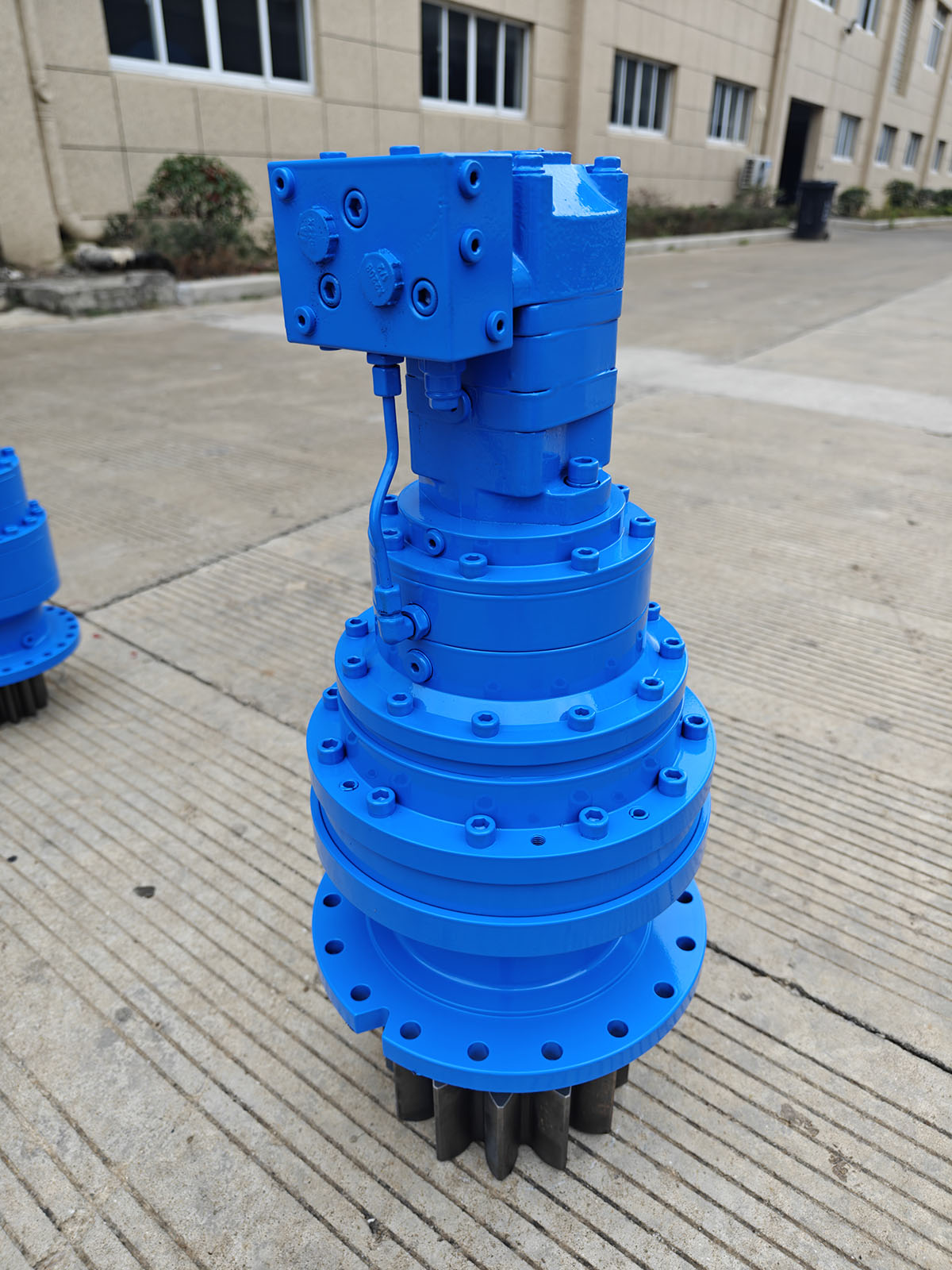
For the common sun-input, fixed-ring and carrier-output arrangement, the ratio is: i = 1 + Zr / Zs. The formula changes for other input, output and fixed-member configurations.
Multiply the ratios of the three stages: itotal = i1 × i2 × i3, provided the stages are connected in series using the stated reduction arrangement.
The total ratio depends on the ratio selected for each stage. For example, 4:1 × 4:1 × 4:1 produces 64:1, while 5:1 × 5:1 × 4:1 produces 100:1. Actual available ratios depend on the specific gearbox architecture.
A higher reduction ratio normally lowers output speed and increases output torque. Actual torque multiplication is reduced by transmission losses and limited by the mechanical capacity of the gearbox.
Multiple stages allow a much higher overall reduction while retaining a compact, coaxial transmission layout. The appropriate number of stages depends on required ratio, torque, speed, package size and duty cycle.
Share your required reduction ratio, input speed, output torque, installation dimensions and application. Kemer can review the operating requirements and recommend a suitable planetary gearbox configuration.
View Planetary Gearbox Solutions


