
Views: 222 Author: Amanda Publish Time: 2026-01-04 Origin: Site


Content Menu
● What Is a Planetary Gearbox?
>> Sun Gear
>> Ring Gear
● How a Planetary Gearbox Works
● Speed Ratios and Operating Modes
● Advantages of a Planetary Gearbox
● Typical Applications of Planetary Gearbox Systems
● Planetary Gearbox in Hydraulic Systems
● Design Considerations for a Planetary Gearbox
● Operation, Maintenance, and Reliability
● FAQ
>> 1. What is a planetary gearbox?
>> 2. Why choose a planetary gearbox over a traditional gearbox?
>> 3. Where is a planetary gearbox commonly used?
>> 4. How efficient is a planetary gearbox?
>> 5. How should I select the right planetary gearbox for my application?
A planetary gearbox is a compact, high-torque transmission system that arranges several gears around a central axis to transfer power efficiently in a small volume. By distributing load across multiple gear meshes at the same time, a planetary gearbox combines high power density, smooth operation, and excellent reliability for demanding industrial and mobile applications.[1][2]

A planetary gearbox (also called an epicyclic gearbox) is a gear train in which several planet gears orbit a central sun gear while meshing with an internally toothed ring gear. All planet gears are mounted on a carrier that supports them and usually serves as either the input or output element of the planetary gearbox.[3][4]
In a typical planetary gearbox:
- The sun gear is located at the center and transmits torque to or from the system.[1]
- Several identical planet gears surround the sun, sharing the transmitted load among multiple paths.[3]
- The ring gear forms the outer circumference, with internal teeth that mesh with every planet gear at once.[3]
- The carrier holds the planet gears and can act as a structural support, an input, or an output of the planetary gearbox.[4]
Because the main elements of a planetary gearbox share a common axis, the input and output shafts can be arranged coaxially, which is a major packaging advantage over many conventional gearboxes. This coaxial form factor allows the planetary gearbox to be integrated inside drums, hubs, and compact housings where radial space is limited but high torque is required.[2][5]
The sun gear is the central driving or driven gear of the planetary gearbox and normally has external teeth. It is often connected directly to a motor, such as an electric or hydraulic motor, providing high-speed, low-torque input into the planetary gearbox that is later converted to high torque at reduced speed.[6][1]
The size and tooth count of the sun gear influence the gear ratio of the planetary gearbox and affect how much torque multiplication is achieved. When the sun gear is used as the input, its rotation forces the surrounding planets to roll between the sun and the ring gear, initiating the characteristic orbital motion in the planetary gearbox.[7][4]
Planet gears are identical gears that rotate around the sun gear while simultaneously meshing with the ring gear, and they are mounted on pins or shafts fixed to the carrier. Typically, a planetary gearbox uses three or more planet gears, with some heavy-duty designs employing four or more planets to further increase torque capacity and stiffness.[2][3]
The carrier is the structural frame that supports the planet gears and maintains the correct center distances among sun, planets, and ring inside the planetary gearbox. In many industrial planetary gearbox designs, the carrier is connected to the output shaft, so the orbital motion of the planets causes the carrier to rotate and deliver slow-speed, high-torque output.[8]
The ring gear is an annular gear with internal teeth that mesh with all of the planet gears in the planetary gearbox. It often serves as the stationary member by being bolted to a housing or machine frame, but in some configurations the ring gear can also be driven or used as the output of the planetary gearbox.[9][3]
By fixing or driving different members (sun, carrier, ring), engineers can obtain different gear ratios, directions of rotation, and torque characteristics from the same basic planetary gearbox geometry. The ring gear also contributes to the compactness of the planetary gearbox by acting as both a gear and a structural outer shell.[2][3]
In the most common reduction configuration, the sun gear is the input, the ring gear is fixed, and the carrier is the output of the planetary gearbox. When the sun gear rotates, the planet gears mesh with both the sun and the stationary ring, causing the planets to roll around the sun and drive the carrier at a slower speed while multiplying torque.[4][8]
Key operating principles of the planetary gearbox:
- Multiple gear meshes: Because several planet gears share the torque, each gear experiences lower individual tooth loading, boosting the overall torque capability and durability of the planetary gearbox.[2]
- Balanced forces: The symmetric distribution of planets around the sun leads to balanced radial forces, which reduce shaft bending and vibration inside the planetary gearbox.[1]
- Versatile kinematics: By choosing which member is held, which is driven, and which is the output, the planetary gearbox can provide reduction, overdrive, or reverse rotation without changing the basic hardware.[3]
In more advanced systems, a multi-stage planetary gearbox is created by stacking two or more planetary stages in series on a common axis. Each stage provides its own reduction, and the overall gear ratio is the product of the individual ratios, enabling very high reductions while keeping the planetary gearbox compact in diameter.[4][2]
A planetary gearbox supports several operating modes, each defined by which element is fixed, which is the input, and which is the output. This flexibility is one of the main reasons planetary gearbox designs are common in automatic transmissions, heavy machinery drives, and precision servo systems.[10][3]
Typical configurations include:
- Reduction mode: Sun = input, ring = fixed, carrier = output; this is the classic low-speed, high-torque configuration of a planetary gearbox used in winch and travel drives.[8]
- Overdrive mode: Sun = input, carrier = fixed, ring = output; in this mode, the ring can rotate faster than the sun, providing overdrive with changed direction in some planetary gearbox designs.[9]
- Differential / reverse modes: By holding the carrier or ring and driving another member, a planetary gearbox can invert direction or act as a differential mechanism, as seen in automotive and industrial transmissions.[3]
Compound planetary gearbox designs combine several sun, planet, and ring sets with different tooth counts to achieve more complex ratios and multiple speeds in a single compact unit. These advanced planetary gearbox arrangements are particularly useful where space is limited but a broad range of torque and speed settings is required.[7][10]
A planetary gearbox offers several notable advantages when compared with conventional parallel-shaft or helical gearboxes. Its unique geometry enables a combination of compactness, strength, and efficiency that is difficult to match with other gear arrangements.[1][2]
Key benefits of a planetary gearbox:
- High torque density: Multiple planet gears share the transmitted torque, allowing a planetary gearbox to deliver very high output torque relative to its size and weight.[2]
- Compact, coaxial design: Because input and output align along the same axis, the planetary gearbox occupies less space and fits easily into drums, hubs, and tight machine compartments.[5]
- High efficiency: With well-designed tooth geometry and proper lubrication, a planetary gearbox can reach efficiencies exceeding 95%, minimizing energy losses.[1]
- Low backlash and smooth running: The evenly distributed load and simultaneous gear engagements reduce backlash and vibration, improving positioning accuracy and smoothness in a planetary gearbox.[5]
- High reliability and long service life: Robust construction, balanced forces, and shared loads make the planetary gearbox well suited for continuous-duty, heavy load, and shock-loaded environments.[11]
These advantages explain why the planetary gearbox has become a standard solution in modern machinery, especially where high power must be delivered in a confined space. In addition, modular construction and standardized interfaces make it easier to adapt a planetary gearbox to different motors and driven machines.[5][2]
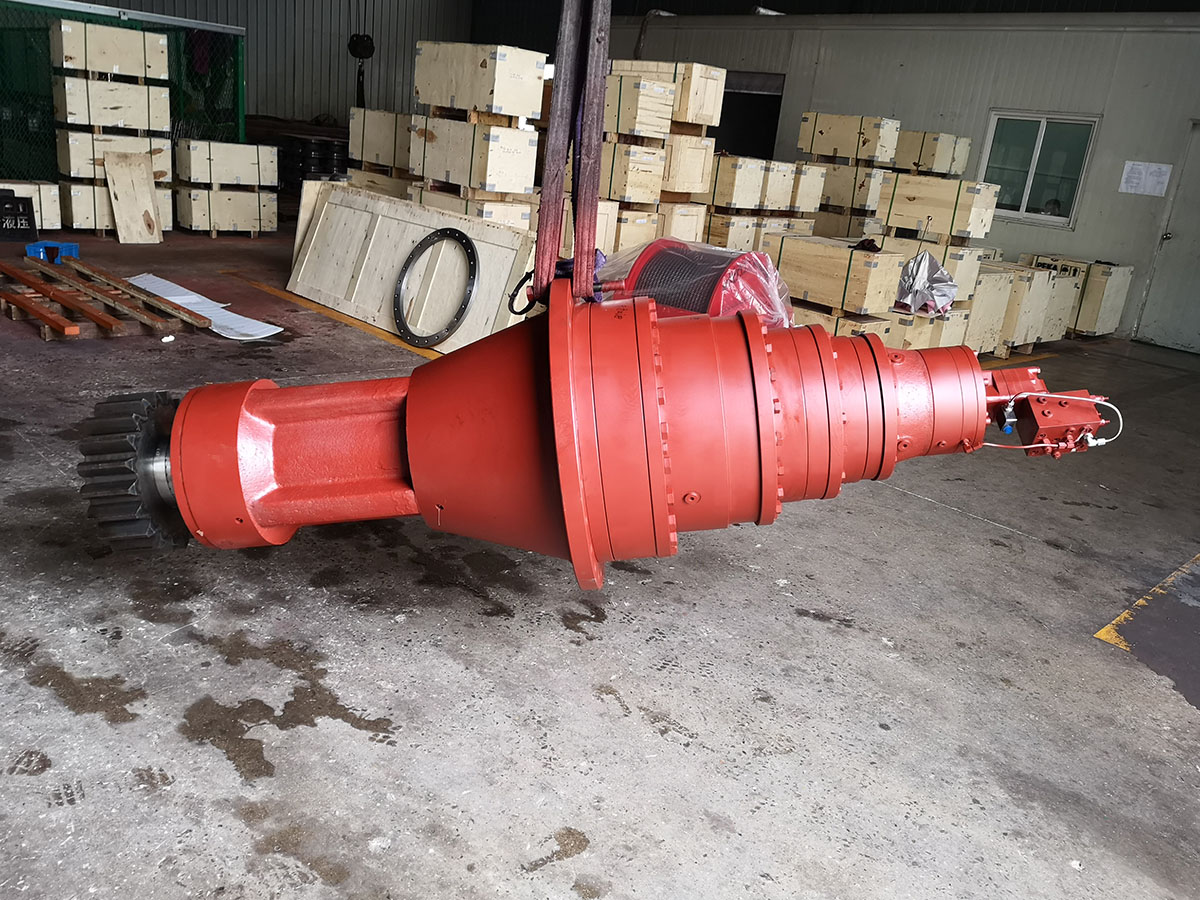
Because of its performance characteristics, the planetary gearbox appears in an exceptionally wide range of applications across many industries. From heavy construction equipment to precision automation, the planetary gearbox is often the preferred choice when engineers need high torque in restricted spaces.[12][5]
Common industrial and mobile uses of a planetary gearbox include:
- Winch drives: A planetary gearbox is integrated into the winch drum or mounted directly to it, providing the high torque and low speed needed for lifting, pulling, and tensioning loads with controlled motion.[13]
- Travel drives and track drives: In crawler undercarriages, a planetary gearbox is combined with a hydraulic motor to form the final drive, delivering strong tractive effort to the track sprockets.[12]
- Swing drives: Excavators, cranes, and drilling rigs use a planetary gearbox as part of the swing drive to rotate the upper structure smoothly with precise control.[14]
- Industrial automation and robotics: Precise planetary gearbox units are used on servo motors for accurate positioning, consistent speed, and low backlash in robots, machine tools, and packaging machinery.[5]
- Mining, offshore, and wind systems: Hoists, slew drives, and pitch drives frequently rely on a planetary gearbox to handle extreme loads and tough environments while maintaining reliability.[2]
The flexibility of the planetary gearbox means that the same fundamental design can be customized for vastly different sectors, simply by changing ratios, bearings, sealing, and housing configurations. This adaptability is one reason the planetary gearbox continues to spread into new application areas as performance expectations rise.[11][1]
In many heavy-duty machines, hydraulic motors and a planetary gearbox are combined to form highly compact and powerful drive units. Hydraulic drives offer flexible speed and torque characteristics, while the planetary gearbox multiplies torque and delivers it to travel, swing, or winch mechanisms.[15][6]
Typical hydraulic combinations involving a planetary gearbox include:
- Hydraulic winch drives: A hydraulic motor drives the sun gear of a planetary gearbox mounted in the winch drum, enabling precise control of lifting and lowering with high line pull.[13]
- Hydraulic travel drives: A planetary gearbox inside the final drive hub converts high-speed motor output into slow, powerful rotation of the track sprocket or wheel hub.[12]
- Hydraulic swing drives: Excavator upper structures and crane slewing systems use a planetary gearbox joined to a hydraulic motor to achieve smooth, controllable rotation even under varying loads.[14]
Because hydraulic systems are often exposed to dirt, moisture, and shock loads, the planetary gearbox in such applications must be carefully sealed, robustly supported, and appropriately lubricated. As a result, manufacturers design sealed planetary gearbox assemblies that integrate bearings, seals, and gear stages into a compact, serviceable module for mobile machines.[6][2]
Selecting or designing a planetary gearbox involves evaluating performance, life, and installation conditions to ensure reliable operation. The internal geometry and size of gears, bearings, and shafts within a planetary gearbox play a crucial role in meeting torque and speed requirements under real-world loading.[4][1]
Important design factors for a planetary gearbox:
- Required torque and ratio: Designers must determine maximum and continuous torque demands, then select a planetary gearbox ratio and number of stages that satisfy those demands with an adequate safety margin.[2]
- Number and size of planet gears: More planet gears improve load sharing and stiffness in the planetary gearbox, but increase complexity and cost; gear size must balance strength and compactness.[12]
- Materials and heat treatment: Carburized, case-hardened alloy steels and precise grinding help a planetary gearbox resist wear, pitting, and scuffing over long operating periods.[11]
- Bearings and support: The carrier, sun shaft, and ring gear interfaces require suitable bearings to handle both radial and axial loads encountered by the planetary gearbox.[8]
- Lubrication and sealing: Proper lubricants and seals protect the planetary gearbox against contamination and overheating, particularly in outdoor, marine, or underground installations.[1]
Beyond the internal design, integration of a planetary gearbox with motors and driven components is also essential. Flange patterns, shaft connections, and mounting options must be chosen so that the planetary gearbox interfaces cleanly with the hydraulic or electric motor on one side and the machine element—such as a winch drum or sprocket—on the other side.[13][2]
To keep a planetary gearbox operating reliably, attention must be paid to lubrication quality, load conditions, and regular inspection. Even though the planetary gearbox is robust, poor maintenance or misuse can shorten its service life.[1]
Key practices that support planetary gearbox reliability include:
- Monitoring lubricant: Checking oil level, viscosity, and contamination helps maintain a protective film on gears and bearings inside the planetary gearbox.[2]
- Observing operating temperature: Excessive heat can indicate overloading, insufficient lubrication, or misalignment, all of which can damage a planetary gearbox if ignored.[11]
- Inspecting seals and fasteners: Regular inspection of seals, bolts, and flanges ensures that the planetary gearbox remains leak-free and securely mounted to its supporting structure.[6]
With appropriate maintenance, a planetary gearbox can operate for many years, even in demanding environments such as construction sites, mines, and offshore platforms. This long service potential makes the planetary gearbox a cost-effective choice over the full life of the machine.[5][12]
A planetary gearbox is a sophisticated yet compact gear system that uses a central sun gear, multiple planet gears, an internal ring gear, and a carrier to transmit power with high torque density and excellent efficiency. By sharing torque across several gears and offering multiple configuration options, the planetary gearbox delivers reduction, overdrive, and reverse functions while remaining smaller and lighter than many conventional gearboxes.[3][2]
From winch drives, travel drives, and swing drives to robotics, automation, and renewable energy systems, the planetary gearbox has become a cornerstone technology in modern mechanical engineering. Understanding the components, operating principles, and design considerations of a planetary gearbox helps engineers, buyers, and equipment users select the right solutions for demanding tasks and maintain them for long, reliable service.[11][5]
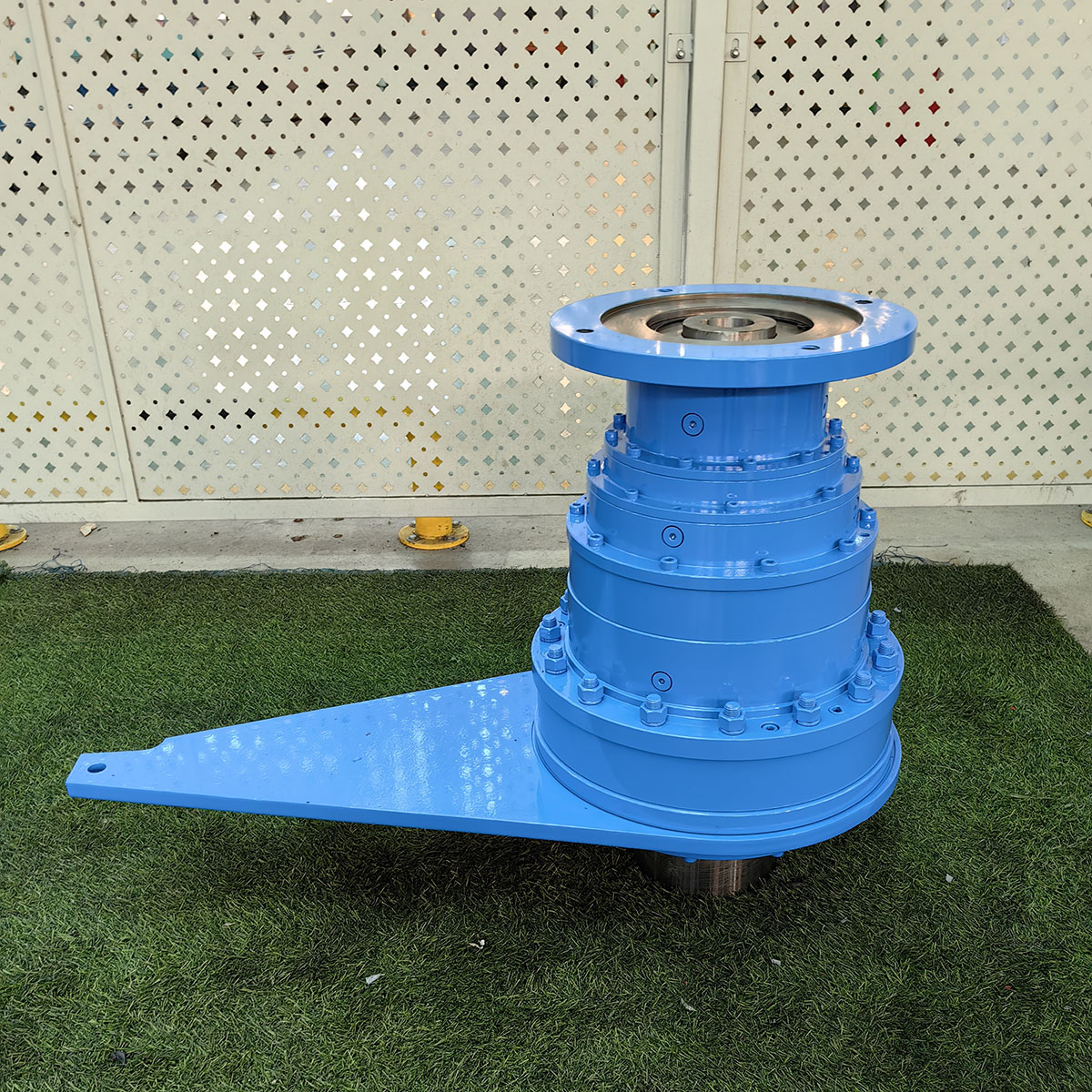
A planetary gearbox is a gear train where several planet gears orbit a central sun gear inside an internal ring gear, all mounted on a carrier that can act as input or output. This arrangement provides high torque in a compact, coaxial form, making the planetary gearbox ideal for space-constrained and heavy-duty applications.[3][2]
A planetary gearbox can transmit higher torque for a given size because multiple planet gears share the load instead of just one or two gears. Its coaxial layout and compact outer diameter also simplify integration into drums, hubs, and tight machine spaces where traditional gearboxes would be bulky.[5][2]
A planetary gearbox is widely used in winch drives, travel drives, swing drives, cranes, and construction machinery where high torque and robust performance are required. It also appears in robotics, machine tools, and multi-speed transmissions that need precise, efficient power transmission with low backlash.[13][5]
Modern planetary gearbox designs typically achieve efficiencies above 95% per stage when correctly lubricated and operated within their rated load and speed. High efficiency results from balanced forces and multiple simultaneous tooth contacts that reduce localized stress and sliding losses in the planetary gearbox.[12][1]
Selecting a planetary gearbox starts with defining required torque, speed, ratio, duty cycle, and environmental conditions such as temperature, dust, or moisture. The planetary gearbox must also be matched to the motor type, mounting arrangement, and expected shock loads to ensure adequate safety margins and long-term reliability.[1][2]
[1](https://assunmotor.com/blog/planetary-gearbox/)
[2](https://www.rollstar.com/en/products/gear-unit/planetary-gear)
[3](https://en.wikipedia.org/wiki/Epicyclic_gearing)
[4](https://www.tec-science.com/mechanical-power-transmission/planetary-gear/epicyclic-planetary-gear/)
[5](https://www.santramengineers.com/the-role-of-planetary-gearboxes-in-high-torque-applications/)
[6](https://www.lancereal.com/planetary-gears-principles-of-operation/)
[7](https://www.mathworks.com/help/sdl/ref/planetarygear.html)
[8](https://www.machinedesign.com/mechanical-motion-systems/article/21834331/planetary-gears-the-basics)
[9](https://www.metmo.co.uk/blogs/news/planetary-gears-explained-a-design-written-in-the-stars)
[10](https://www.rohloff.de/en/experience/technology-in-detail/planetary-gear-system)
[11](https://www.sgrgear.com/news/industry-news/planetary-gearbox-vs-traditional-gearbox-industrial-reliability.html)
[12](https://thmhuade.com/high-torque-planetary-gearbox-applications-gft-track-gearbox/)
[13](https://www.bonfiglioli.com/usa/en/product/fw-series-o-k_winch-drives_winch-drives)
[14](https://www.hrparts.com/blog/post/what-is-swing-drive-diagram)
[15](https://zhihete.com/how-swing-drive-systems-are-essential-components-of-construction-machinery/)


